
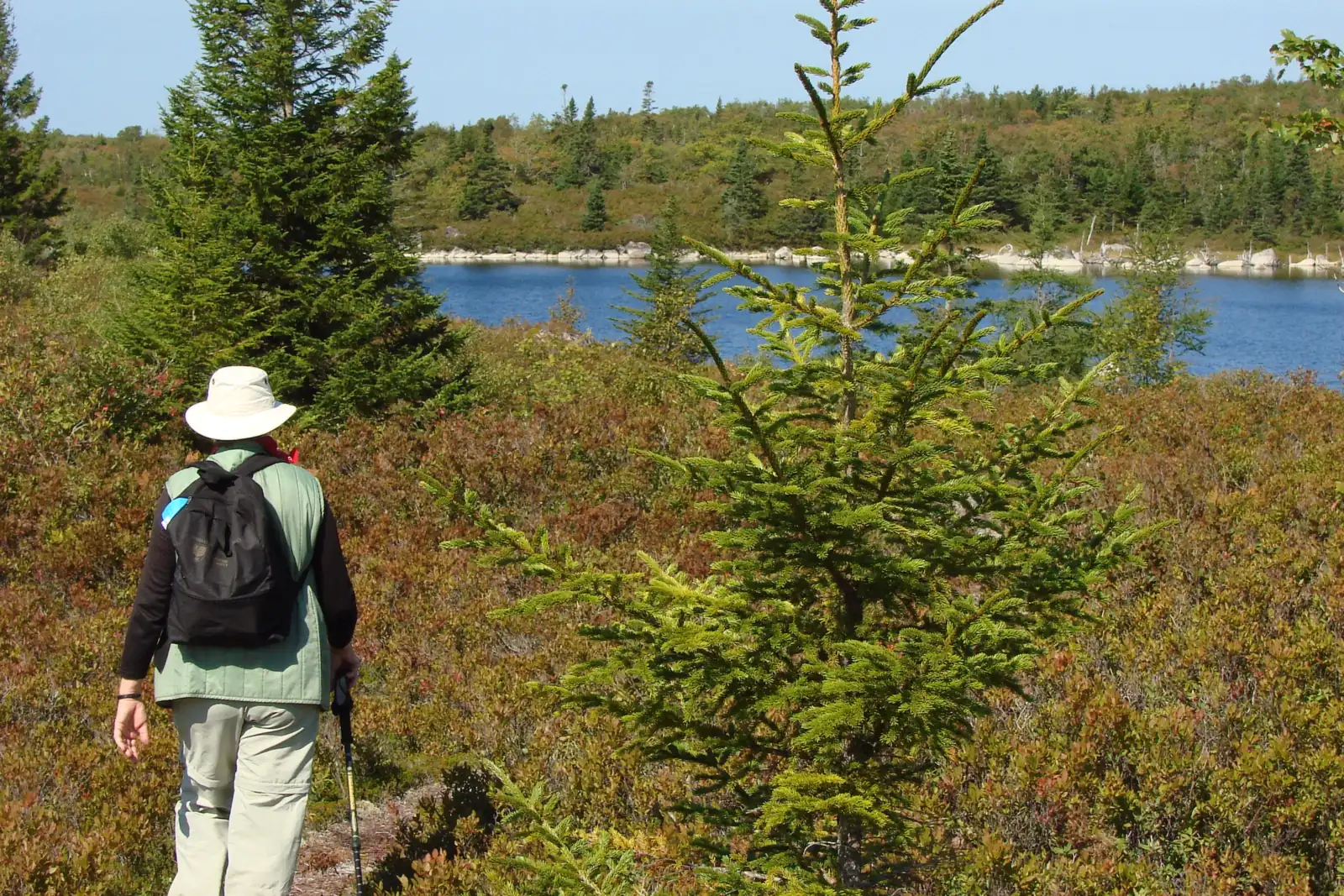
Carry all of this
The list on the trailhead signs, in full. Every item on it has been needed by somebody on this trail at some point.
- Map and compass, and the ability to use both
- First aid kit
- Adequate water, plus a filter or purifier
- Extra food, more than the day requires
- Extra layers of warm, dry clothing
- Rain jacket and rain pants
- Knife
- Emergency matches in a dry container
- Whistle
- Flashlight or headlamp
Carrying a mobile phone is advised, and you should always tell someone outside your group your route and your expected time of return. Do not rely on the phone for navigation: coverage drops out, batteries die in the cold, and a screen is no substitute for a printed map. Plan your excursion to leave plenty of time to return during daylight hours, and cut it short if it is taking longer than expected.
Wildlife, hunting and fire
Bear, moose and coyote
Hikers should be alert: they are travelling through bear and moose country, and there are coyotes here too. Make noise on blind corners and give animals room to leave. Observe wildlife from a distance. Do not follow, approach or feed animals — feeding may cause aggressive behaviour.
Hunting and trapping season
Hunting and trapping are permitted on the land the trail crosses. Deer hunting season runs from the last Friday in October to the first Saturday in December inclusive, and hunting is now permitted on some Sundays within the season. Hunter orange is recommended through this period, and hikers should use The Bluff Trail with added caution. Current rules are on the provincial hunting and trapping page.
Fire
Campfires are prohibited on the trail. The province can also close the woods entirely during wildfire season, as it did from 5 August to 15 October 2025 — check the provincial fire restrictions the morning you head out.
Leave No Trace on The Bluff Trail
The trail runs through ecologically sensitive barrens inside a protected wilderness area. It is generally quite narrow, designed only for walking, and carefully routed to avoid wet areas and especially vulnerable places. These are the principles printed on the signs at every junction and on the Leave No Trace educational site signs.
- Follow official trails
- Travel single file in the centre of the trail, even through wet and muddy areas. Proper footwear handles the wet; walking around it does not.
- Camp only at approved LNT sites
- WRWEO discourages camping altogether, but where people do camp it must be at one of the four NSE-approved Leave No Trace educational sites. See camping.
- Pack out everything you carry in
- Including food scraps, peels and shells, and toilet paper. Do not burn food scraps or garbage.
- Bury human and dog waste
- At least 60 m off trail and away from water, or pack it out.
- Leave natural objects as you find them
- Do not build an inukshuk, furniture, cairns or fire rings. Do not cut trees or pick flowers.
- No campfires
- Campfires are prohibited throughout the wilderness area. A camp stove or a Leave No Trace fire bowl is the only way to cook — what a fire bowl is and how to use one.
- Keep dogs leashed
- Dogs may not run at large. See dogs on the trail for the four reasons why.
- Be courteous to others
- Enjoy the sounds of nature.
The principles are explained in more detail by Leave No Trace Canada, and the province publishes Keep It Wild: a guide for low-impact recreation in Nova Scotia's wilderness areas (PDF).
Harmful human impacts
WRWEO wants to acknowledge the increase in harmful human impacts on The Bluff Wilderness Hiking Trail. The trail sits inside the Five Bridge Lakes Wilderness Area, a designated protected area under the Wilderness Areas Protection Act. WRWEO works closely with Nova Scotia Environment and the Department of Natural Resources to identify solutions, and runs the Bluff Trail Stewardship Program to inform and educate the public. The main concerns are trail widening, trail spurs and braiding, tree cutting, campfires, toilet paper, and human and dog waste.
Trail widening
Widening happens most often when people walk along the edge of the trail rather than down the centre line, usually to avoid a wet patch. It is always better, and it is Leave No Trace practice, to walk in the middle of the trail even when it is wet or soggy. Proper footwear should take care of it. If there are stretches that genuinely cannot be walked through, especially in rainy periods, let WRWEO know so we can address them with trail hardening — using found stone to firm up the tread and give a drier path forward.
Trail braiding
Braiding occurs when users create multiple paths running in the same direction that split off and rejoin the main trail. It often starts with a fallen tree: some people go around one side, some the other. Braids damage and degrade the wilderness, destroying plants and leading to erosion.
Trail spurs
Spurs occur when users leave the trail. Some go to the water's edge, some to a look-off, and some do not go anywhere at all. As well as destroying plants and causing erosion, spurs are a safety problem: a hiker can follow one thinking it is the main trail and become lost or disoriented.
Why it matters
Think of the trail as a wound in the wilderness. Your job is to keep that wound as small as possible. Water follows whatever channels get created, and erosion compounds from there. A wide trail, trail braids and spurs all suppress plant growth and enlarge the footprint of the trail on the protected area around it.
The junction between loops 1 and 2
At the intersection of the first and second loops, a few hikers who are not familiar with the area have been confused: rather than looping back on the Pot Lake Loop they have headed out on the Mi'kmaw Hill Loop, believing they were on their way back to the trailhead and parking lot when in fact they were heading further into the wilderness. This has necessitated at least one wilderness rescue by Halifax Search and Rescue.
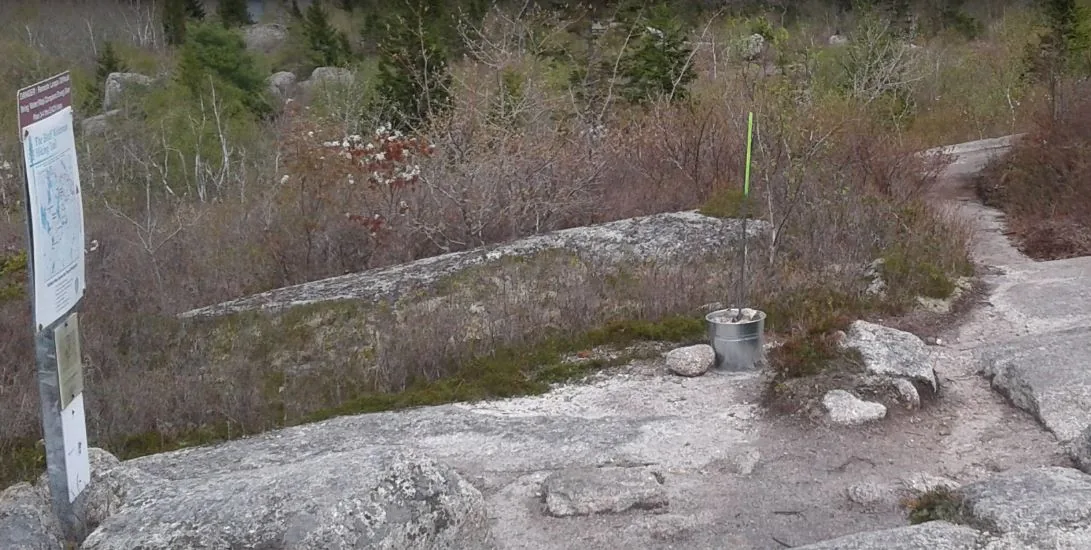
WRWEO created way markers for that junction — lengths of rebar painted the colour of the trail markers, yellow for the Pot Lake Loop and blue for the Mi'kmaw Hill Loop. They help most people who find the spot confusing. The markers and their buckets are also subject to abuse: the rebar has gone missing, thrown into the bushes, and the buckets have been kicked around and used as garbage cans. There are no garbage containers on The Bluff Trail. Every hiker should carry their waste out.
Tell us what you find
Blowdown across the tread, a fire ring, a missing marker, a washed-out section of boardwalk: trail users report all of it, and stewardship volunteers act on the reports. Submit a trail report when you get home. The program logged 130 of them in 2024, and every annual report is built out of them.