The Bluff Trail Woodens River Watershed Environmental Organization

Rules

WRWEO discourages camping on The Bluff Trail

Because of the damage it causes: cut trees, campfire scars, litter, toilet paper and human waste. If you must camp, use one of the four approved Leave No Trace sites and leave no sign you were there.

Camping
Discouraged
Approved sites
4
Campfires
Prohibited
Fire bowls
Permitted

You can reach every loop without camping

Although The Bluff Trail is designed as a stacked loop trail, it is possible to reach even the remote loops without staying overnight. All loops are accessible by canoe and can be explored in a day trip.

Paddling in cuts a six-hour walk to the fourth loop down to under an hour. There are three put-ins, one for each of the outer loops, and getting there has the directions and the portages.

What the law says

The Bluff Trail is inside a protected wilderness area and is governed by the Wilderness Areas Protection Act. Except in certain circumstances, the Act and the Order on Camping and Lighting of Fires in Designated Wilderness Areas prohibit — among other things — the development of campsites, the cutting of trees, damaging or removing plants, and the burning of campfires.

The only camping permitted on The Bluff Trail is Leave No Trace camping, at the designated sites. Because of the increasing harmful human impacts visible on the trail, WRWEO and Nova Scotia Environment's Protected Areas Branch have already limited camping to the approved sites and are considering prohibiting it altogether.

The four approved sites

On 21 August 2016, with the approval of Nova Scotia Environment, WRWEO designated three sites on The Bluff Trail as NSE Approved Leave No Trace Educational Camping Sites and posted signs at each. A fourth was added subsequently. Two are on the north leg of the Mi'kmaw Hill Loop, not far from Frederick Lake and the intersection with the Bluff Loop; the third is on the cross-section of the Bluff Loop.

Coyote U'lukwej 44.64224, −63.78316
Crow Ka'qaquj 44.64116, −63.78411
Squirrel Atutu'wej 44.63094, −63.79530
Moose Tia'm 44.63124, −63.81186

Why they are called “educational” sites

They cannot be held up as examples of ideal Leave No Trace camping. By placing signs to notify hikers of the designation, we have already left a trace and undermined the very principle we are promoting. Ideal LNT campsites would not sit directly on an established hiking trail, and all four of these do. And each of them was already marked with evidence of harmful human impacts before it was selected.

All four are on flat rock, which is an excellent durable surface for a tent. But the lichen and mosses have already been crushed, killed or scraped off those rocks. A number of spots bear the signs of campfires, and some of the nearby trees have been limbed or cut for boughs to sleep on or fuel to burn. These are all examples of how not to camp, which is exactly what makes them useful for teaching.

They are not even the worst-damaged places on the trail. There are at least two sites on the Mi'kmaw Hill Loop with considerably more damage from campers and campfires: more than twenty trees cut down at each, trees limbed and hacked, soil layers damaged by poorly placed and far too large campfires, and fire damage to the tree canopy above.
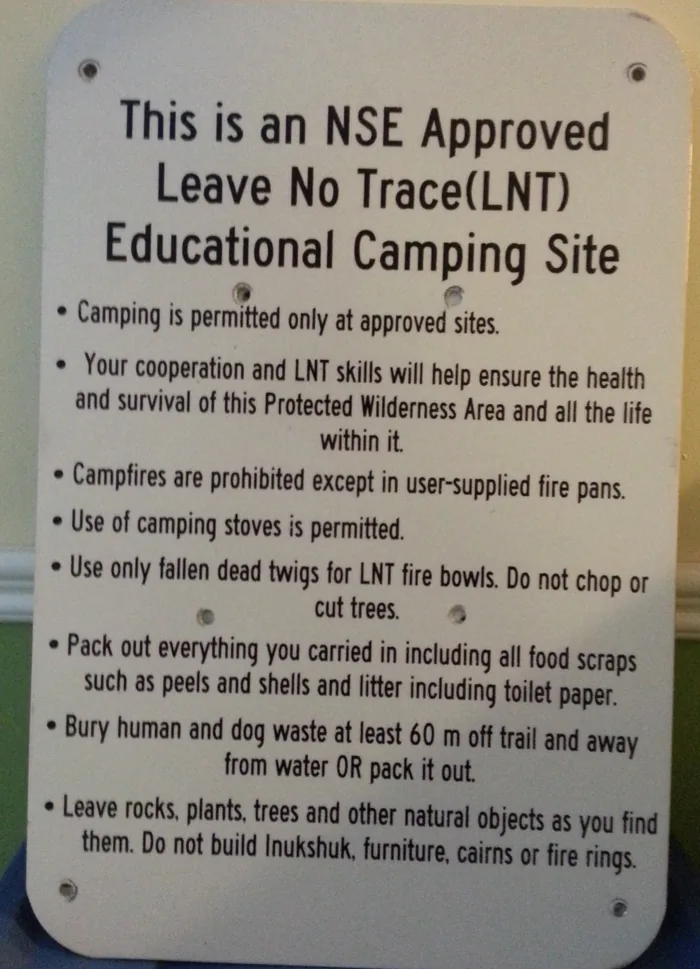
The white NSE Approved Leave No Trace Educational Camping Site sign, listing the rules for camping, fires, waste and natural objects.
The sign posted at each of the four approved sites, 21 August 2016.

Practice

How to camp without leaving a mark

If you are going to camp here anyway, this is how to do it without leaving damage behind.

It is impossible to camp without leaving any trace at all, but it is possible to minimize the harm. Sleeping, cooking and defecating all leave a mark on the wilderness, and the majority of people do not know how to camp without partly — and over time wholly — destroying the area they camp in. People clear ground to pitch a tent, build fires to cook, and leave faeces and toilet paper near their sites. All of this is prohibited here.

  • Sleep. It is possible to sleep in the forest, even sheltered from the rain, and leave no visible sign that you were there. Pitch on the flat rock. Do not clear ground, cut boughs or build furniture.
  • Cook. Use a camp stove, or a Leave No Trace fire bowl. A fire bowl is a steel pan or steel bowl, set on a hard surface so the ground underneath is not scorched, burning only found dead wood — and try not to strip an area of all its dead wood. Campfires themselves are prohibited throughout the Five Bridge Lakes Wilderness Area. Carry the bowl inverted on the top of your pack.
  • Toilet. Use natural materials instead of toilet paper where you can, and bury faeces. Unburied faeces decompose in about six months; buried six inches deep they take twice as long. Ideally carry both faeces and toilet paper out; the workable compromise is to bury the waste and carry the paper. Defecate well away from streams and lakes, at least 60 m off trail.
  • Site. Camp only at one of the four designated Leave No Trace educational sites.

Leaving no trace can be fun. You can treat it as a challenge that makes camping more interesting than it would otherwise be, and it leaves out none of the things that make camping a pleasure. Leaving no trace can be a point of pride.

Do not leave a car overnight

We ask you not to leave your car overnight in the parking lot. Have someone drop you off and arrange for someone to pick you up. That way somebody knows right away that there is a problem if you do not return on time.

The Leave No Trace principles are on our signs at every junction of the trail, on the educational site signs, and in the volunteer handout. The full set, with the province's low-impact recreation guide, is on before you go.

To sum up: we discourage camping on The Bluff Trail — but if you must camp, please leave no trace that you have been there.